
Statement from the Humanitarian Organization for Migration Economics (HOME) in response to the redevelopment of 2 Migrant Worker Recreation Centres
As Singapore continues to rely heavily on migrant workers across key sectors, it is important that their social wellbeing, including access to meaningful rest and community spaces, is recognised and strengthened.
Recreation Centres (RCs) can play an important role in fostering community, rest, and dignity. At HOME, some community groups, including the HOME Sports Volleyball team, Skate Club, and Yoga Club regularly use these spaces on Sundays. We have seen firsthand how they can provide migrant workers with moments of relief and connection at no additional cost.
However, accessibility remains a significant concern. Many recreation centres are located in remote areas with limited public transport options, making them difficult to reach, particularly for migrant domestic workers who already face constraints on time, mobility, and autonomy. The location of these spaces risk reinforcing rather than reducing social isolation.
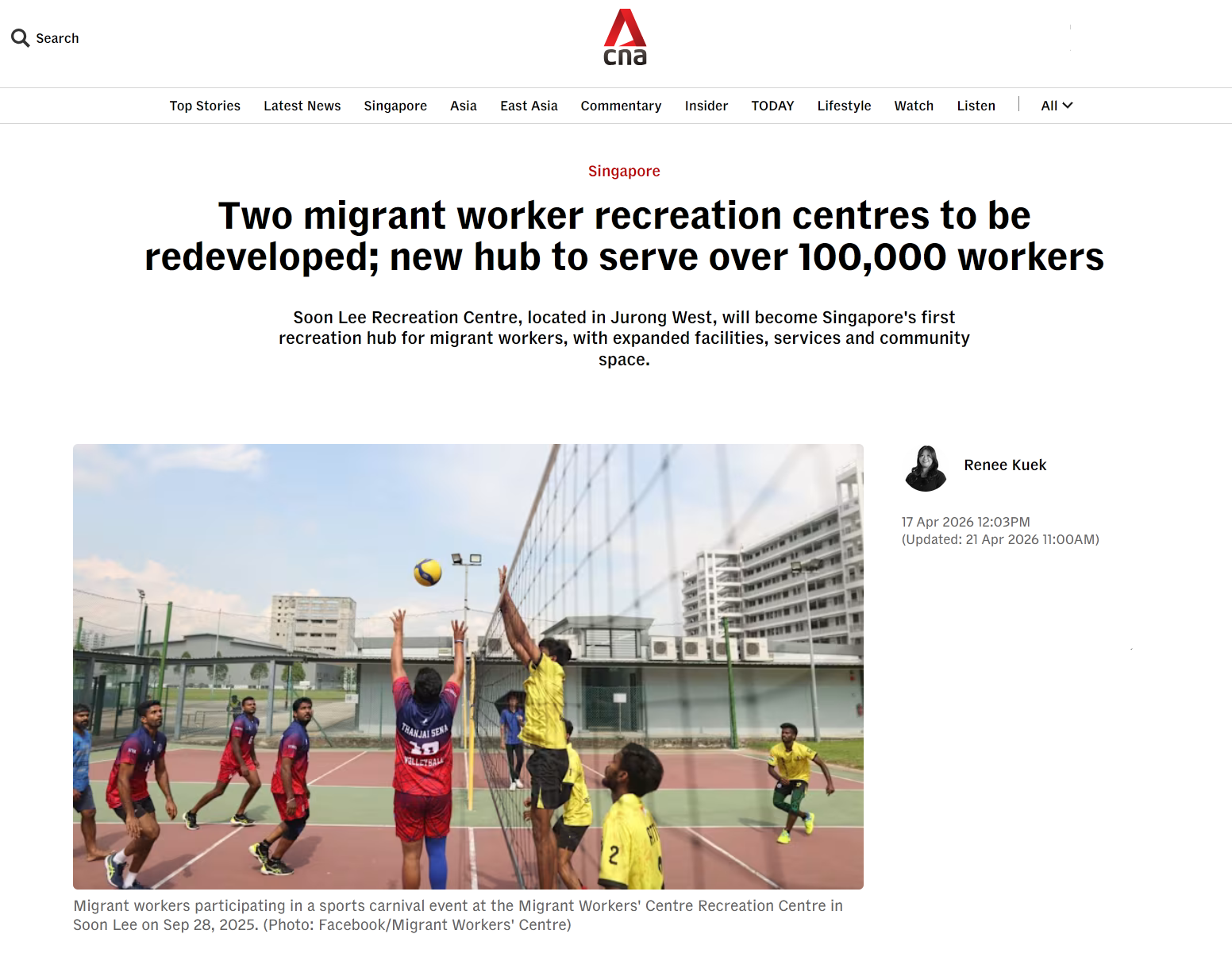
Screenshot of CNA article about the redevelopment of 2 Migrant Worker Recreation Centres.
RCs have also been envisioned as preferred “destinations” for migrant workers. At the same time, some have characterised migrant workers’ gathering in public spaces as sources of “disamenities.” We should take care not to create the impression of deliberately segregating their social spaces from the wider community, lest migrant workers feel unwelcome in our shared public environments. Over the longer term, our aim should be to develop inclusive community spaces that meaningfully accommodate and welcome both migrant and local populations.
Importantly, improvements to the RCs must not distract from the more fundamental structural issues shaping migrant workers’ lives in Singapore. Access to recreation is meaningful only when workers have the time, freedom, and financial security to enjoy it. This includes fair wages, guaranteed rest days, the elimination of excessive recruitment fees and debt bondage, protection against wage theft, and stronger safeguards against exploitative working conditions. Unfortunately these are issues we continue to see reflected in a growing number of cases at our helpdesks.
Improving the lives of migrant workers requires more than well-designed spaces. It requires a sustained commitment to dignity, labour rights, and inclusion. HOME urges the government to take a holistic approach that combines improved infrastructure with meaningful policy reforms to address the structural issues that facilitate the continued exploitation of migrant workers in Singapore.